Wilder's cabin
Insatiable Box Set: Books 1-4Wilder's cabin is a large, newly constructed home in a snowy forest clearing, built by Wilder as a claimed refuge for himself and Adrienne. Its first appearance makes it both a physical shelter and a test of their relationship: Wilder calls it home and offers it as a sign of reunion, while Adrienne enters it unwillingly, questioning whether a place designed without her consent can belong to her at all.
Setting and Design
Wilder reaches the cabin by slowing the truck, leaving the main road, and driving into pitch-dark woods. LED lamps illuminate the expansive home in the middle of a clearing, while falling snow settles over the surrounding pines. A graveled road leads toward the building, and a bump in that road wakes Adrienne before she sees the faint lights and the cabin ahead. The structure is made of redwood timber and is large enough to dominate its clearing. A second-floor balcony overlooks the woods, and broad panoramic glass windows project from the front. The design combines isolation with display: the cabin is hidden deep in the forest, yet its lamps, scale, and windows make it an impressive and carefully prepared domestic environment rather than a rough wilderness shelter.
A Refuge Shaped by Werewolf Presence
The forest around Wilder's cabin is unusually quiet. Some animals are asleep or searching for food, but Adrienne also understands the silence through her knowledge of wild animals and werewolves. The scent of a werewolf living nearby would repel smaller animals, making them less likely to approach the cabin. The setting therefore reflects Wilder's nature as much as his construction: the home is embedded in a landscape whose ordinary life has been altered by the presence of a werewolf. That natural isolation also carries practical and emotional force. Adrienne has recently survived captivity and a dangerous escape, and she has already learned to associate wilderness with both refuge and threat. The cabin offers warmth and shelter from the snow, but its remoteness means that Wilder controls the environment into which he brings her. The same woods that protect the home can also make it feel like a place from which departure will be difficult.
Wilder's Claim of Shared Home
When the truck stops, Wilder smiles and tells Adrienne that they are home. He has built the cabin for the two of them, speaking with the shy eagerness of a young man trying to impress his bride. His language reveals a private domestic plan: he treats the building as material proof that their bond can be restored and given a permanent setting. The cabin is consequently an object of courtship, possession, and projection. Wilder has invested labor and expectation in a future that he appears to regard as already established. He asks Adrienne to climb out and see the place, opens the passenger door for her, and encourages her to listen to him. His gestures are attentive, but they also assume that she will accept the meaning he has assigned to the cabin.
Adrienne's Refusal and the Threshold Scene
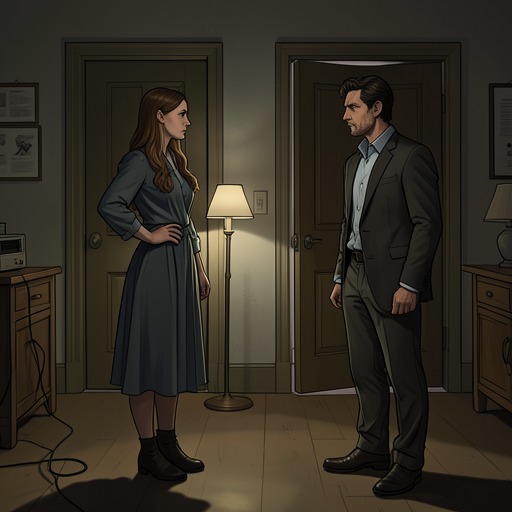
Adrienne immediately rejects Wilder's definition. She says that the cabin is not her home, questions who authorized its construction, and points out that Wilder did not consult her, Drayton, or Lycell. She has been separated from her children for more than a week, is hungry, has not eaten decent food, and distrusts the werewolf she once believed she loved. Her response transforms the cabin from a triumphant reunion site into a scene of accusation. She agrees to look around only because the cold and hunger make remaining in the truck impractical, and she explicitly says that she is not staying. When Wilder offers his hand, she refuses his help; when he places a hand behind her waist to steady her in the deep snow, the gesture is protective but occurs despite her resistance. The building impresses her visually, yet admiration for its appearance does not produce consent to its purpose. The doorway intensifies the conflict. Wilder opens the front door and offers to carry Adrienne over the threshold, invoking the ritual associated with married couples. Adrienne steps inside rather than allowing him to perform that gesture, then reminds him that she is married to Drayton and that the ceremony belongs to a man and a woman. By refusing to be carried, she refuses the symbolic transformation Wilder wants the cabin to enact. The threshold marks not her willing arrival into a new household, but her insistence that physical entry does not settle emotional, marital, or legal belonging.
Narrative Significance
Wilder's cabin concentrates the novel's recurring tension between protection and control. Wilder has created a beautiful, well-lit home in an otherwise dark and frozen landscape, but the home cannot repair the breach produced by Adrienne's captivity, separation from her children, and distrust of Wilder's jealousy. Its warmth and grandeur belong to Wilder's imagined future; Adrienne's words restore the absent questions of permission, marriage, family, and choice. As a location, the cabin is therefore less a completed sanctuary than a contested threshold. Wilder sees construction as an act of devotion and assumes that a shared house can make a shared life real. Adrienne sees the same act through the circumstances of her return: she has been brought into a place chosen without her, by a man whose identity and conduct she now doubts. The cabin's decisive significance lies in that contrast. It is built to house reconciliation, yet its first domestic scene exposes how far reconciliation still remains from being achieved.